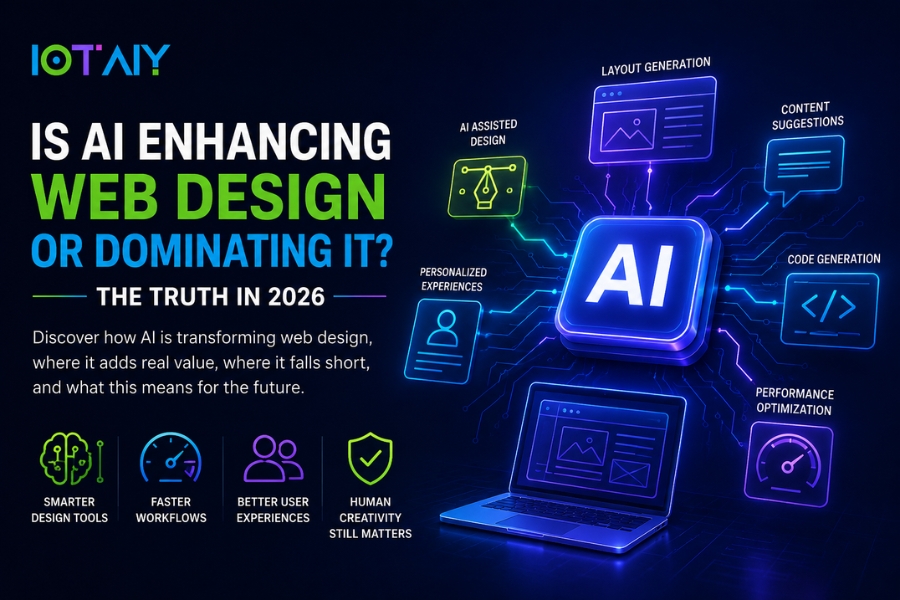
Artificial intelligence is reshaping how websites are designed, built, and experienced. From layout generation to personalized user journeys, AI tools are now embedded in nearly every stage of the web design process. This has sparked an ongoing debate: is AI simply enhancing the work of designers, or is it slowly taking over the creative process altogether?
As AI-powered design platforms become more capable, businesses are rethinking how websites are planned, prototyped, and maintained. Consequently, designers, developers, and business owners are asking whether AI is a collaborative tool or a replacement for human creativity.
In this article, we explore how AI is influencing web design in 2026, where it adds genuine value, where its limitations remain, and what this means for the future of the design industry.
What Does AI in Web Design Actually Mean?
AI in web design refers to the use of machine learning, generative models, and automation tools to assist with or perform tasks traditionally handled by human designers.
Rather than replacing the entire creative process, AI tools typically work alongside designers to speed up repetitive or technical tasks.
- Automated layout generation
- Content and copy suggestions
- Image and asset creation
- Code generation from designs
- Personalization and behavioral targeting
As a result, teams can move from concept to prototype far faster than with manual design workflows alone.
Why This Debate Matters in 2026
AI design tools have matured significantly, and adoption is no longer limited to early adopters or large enterprises. Therefore, understanding AI’s real role in web design has become important for businesses making technology decisions.
- Widespread adoption of AI design platforms
- Growing pressure to launch websites faster
- Rising client expectations for personalization
- Concerns over originality and brand identity
- Shifting roles within design teams
Thus, businesses need clarity on where AI genuinely helps and where human judgment remains essential.
Areas Where AI Is Enhancing Web Design
In many parts of the design process, AI acts as a productivity multiplier rather than a replacement for designers.
- Wireframing and rapid prototyping
- Design system consistency checks
- Accessibility auditing
- A/B testing and optimization suggestions
- Responsive layout adjustments
Consequently, designers can spend more time on strategy, branding, and user experience decisions that require human judgment.
Key Benefits of AI-Assisted Web Design
AI-assisted design workflows offer several advantages that directly impact speed, consistency, and user experience.
Faster Design Iteration
Manual design cycles can be slow, especially when exploring multiple concepts. AI tools generate variations quickly, allowing teams to iterate without starting from scratch each time.
- Rapid concept generation
- Quicker stakeholder feedback loops
- Reduced production time
- Fewer manual revisions
- Faster time-to-launch
Improved Personalization
AI enables websites to adapt content and layout based on user behavior, improving relevance and engagement.
- Dynamic content recommendations
- Behavior-based layout adjustments
- Targeted messaging
- Improved conversion pathways
- Real-time personalization
Stronger Accessibility and Usability
AI tools can flag usability and accessibility issues that are easy to miss during manual reviews.
- Automated accessibility scans
- Color contrast and readability checks
- Consistent navigation patterns
- Faster issue detection
- Improved compliance with standards
Design and Development Efficiency
AI bridges the gap between design and development by generating usable code and reducing handoff friction.
- Design-to-code automation
- Reduced developer workload
- Fewer implementation errors
- Streamlined collaboration
- Faster deployment cycles
Signs AI Might Be Dominating Rather Than Assisting
While AI offers clear benefits, over-reliance on automated tools can introduce risks that businesses should watch for.
- Websites that look generic or templated
- Loss of unique brand identity
- Reduced human oversight in design decisions
- Heavy dependence on a single AI platform
- Minimal customization beyond AI defaults
If your website design process relies entirely on automation, it may be worth reintroducing human-led creative direction.
Popular AI Use Cases in Web Design
AI is being applied across multiple stages of the website design and development lifecycle.
Generative Design and Prototyping
Designers use AI to quickly explore layout options and visual directions before committing to a final design.
- Automated wireframe generation
- Style and color palette suggestions
- Multiple design variations
- Faster concept validation
Content and Copy Generation
AI supports content creation by drafting website copy that designers and marketers can refine.
- Headline and CTA suggestions
- SEO-oriented content drafts
- Tone and style adjustments
- Multilingual content support
UX Optimization and Testing
AI-driven analytics help teams understand how users interact with a website and where improvements are needed.
- Heatmap and behavior analysis
- Automated A/B testing
- Conversion rate optimization
- User flow recommendations
Challenges Businesses Face with AI in Web Design
Although AI offers significant advantages, adopting it effectively requires careful planning and human oversight.
- Risk of generic or repetitive design outcomes
- Difficulty maintaining unique brand voice
- Data privacy and ethical considerations
- Integration with existing design workflows
- Balancing automation with creative control
Therefore, businesses often work with experienced design and development teams to strike the right balance.
Where Human Designers Remain Essential
Despite advances in AI, certain aspects of web design still depend heavily on human judgment and creativity.
- Brand strategy and storytelling
- Emotional and cultural nuance
- Original visual identity
- Complex user experience decisions
- Client relationship and creative direction
As a result, the most effective websites tend to combine AI efficiency with human creative oversight.
How AI Is Shaping the Future of User Experience
User expectations continue to rise in 2026, and AI plays a growing role in meeting those expectations without sacrificing usability.
- Faster, more responsive websites
- Smarter personalization
- Improved accessibility
- More intuitive navigation
- Continuous, data-driven improvement
Consequently, businesses that use AI thoughtfully often see stronger engagement and user satisfaction.
How IOTAIY Helps Businesses Balance AI and Human-Led Web Design
IOTAIY helps businesses build modern, high-performing websites by combining AI-driven efficiency with experienced human design and development expertise. In addition, the company provides strategic guidance to ensure AI tools support, rather than replace, brand identity and creative vision.
Web Design and Development Services
- Custom website design
- AI-assisted prototyping
- Responsive and accessible design
- UX/UI strategy
- Design system development
AI-Enhanced Design Solutions
- Personalization and behavior-based design
- Design-to-code automation
- Content generation support
- Automated accessibility auditing
- Performance and UX optimization
Consulting and Support
IOTAIY helps businesses evaluate where AI adds value in their design process and implement solutions that preserve brand identity.
- Technology and design consulting
- Workflow assessment
- AI tool integration planning
- Ongoing design and development support
- Long-term website maintenance
Business Impact of AI in Web Design
Organizations that adopt AI thoughtfully in their design process often see measurable improvements across multiple areas.
| Design Area | Impact |
|---|---|
| Design Speed | Faster iteration and delivery |
| Personalization | Higher engagement and relevance |
| Accessibility | Improved compliance and usability |
| Brand Identity | Requires human oversight to maintain uniqueness |
About IOTAIY
Learn more about the company by visiting the About Us page. IOTAIY provides web design, AI-assisted development, custom software development, mobile applications, and digital transformation solutions for businesses worldwide.
Get Started with AI-Enhanced Web Design
If your business wants to combine the speed of AI with the creativity of experienced designers, IOTAIY can help. Visit the Contact Page to discuss your website design requirements.
The Future of AI in Web Design
Web design will continue to evolve as AI tools become more capable and more deeply integrated into design workflows. However, the most successful websites will likely be those that use AI as a creative accelerator rather than a full replacement for human designers.
Meanwhile, IOTAIY continues helping organizations build websites that combine AI-driven efficiency with authentic, human-led brand identity.
Conclusion
AI is not simply dominating web design, nor is it a passing trend that only enhances minor tasks. It sits somewhere in between, automating repetitive work, accelerating iteration, and enabling personalization, while still depending on human designers for strategy, originality, and emotional connection.
Businesses that treat AI as a collaborative tool rather than a replacement for creative talent are best positioned to build websites that are fast, functional, and distinctly their own.
Frequently Asked Questions (FAQ)
| 1. Is AI replacing web designers? |
|---|
| No, AI is largely automating repetitive tasks like layout generation and testing, while human designers remain essential for brand strategy, creativity, and original visual identity. |
| 2. What are the biggest benefits of using AI in web design? |
| AI speeds up design iteration, improves personalization, strengthens accessibility, and streamlines the handoff between design and development. |
| 3. Can over-reliance on AI hurt a website’s design? |
| Yes, relying too heavily on AI defaults can lead to generic, templated designs that lack unique brand identity, which is why human oversight remains important. |
| 4. Which parts of web design benefit most from AI? |
| Common use cases include prototyping, accessibility auditing, personalization, A/B testing, and design-to-code automation. |
| 5. How can IOTAIY help businesses use AI in web design effectively? |
| IOTAIY combines AI-assisted design tools with experienced human designers and developers to build fast, accessible, and brand-authentic websites. |