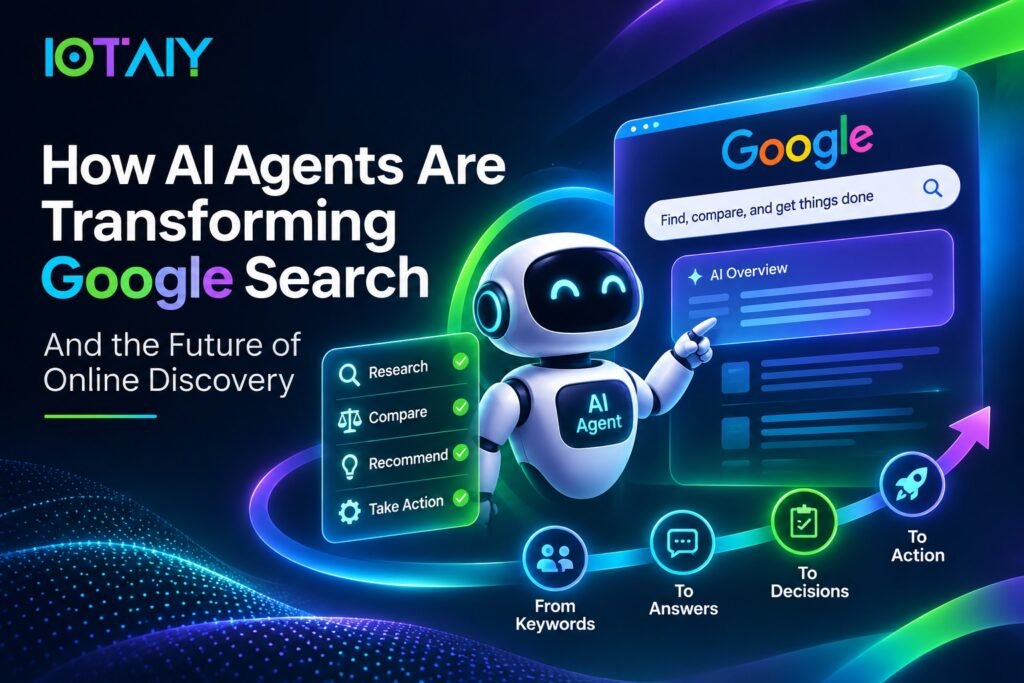
The future of search is no longer just about finding websites. It is about intelligent AI agents finding answers, evaluating options, and helping people make decisions.
For years, Google Search has been the starting point for discovering information, researching products, comparing services, and finding businesses online. Users entered keywords, reviewed search engine results pages (SERPs), opened multiple websites, and manually decided which information they could trust.
That behavior is changing.
Artificial intelligence is transforming how people search, consume information, and interact with the internet. From AI-generated search summaries to conversational search assistants and autonomous AI agents, the traditional search experience is evolving into something far more intelligent, personalized, and action-oriented.
Instead of simply displaying ten blue links, modern AI-powered search experiences can synthesize information from multiple sources, understand complex questions, maintain conversational context, and help users move closer to a decision.
Google is actively advancing this transformation through AI Overviews, AI Mode, and emerging agentic capabilities. Its May 2026 Search announcements also highlighted information agents and expanded agent-assisted booking and shopping experiences.
For businesses, marketers, and technology leaders, this evolution introduces an important question:
What happens when AI agents become an increasingly important gateway between customers and the businesses they discover online?
At IOTAIY, we believe understanding this shift is essential for organizations preparing for the next generation of digital discovery, intelligent automation, and AI-powered customer experiences.
In this article, we explore how AI agents are transforming Google Search, why traditional search behavior is evolving, what this means for SEO, and how businesses can prepare for an AI-driven future.
What Are AI Agents?
AI agents are intelligent software systems designed to pursue goals, interpret information, make decisions, and perform tasks with varying degrees of autonomy.
Unlike traditional software that follows only predefined instructions, AI agents can use large language models (LLMs), external tools, APIs, search systems, and contextual information to determine how to approach a task.
Depending on their capabilities and permissions, an AI agent may be able to research a topic, compare products, retrieve information from different sources, interact with business systems, or execute a multi-step workflow.
For example, consider someone looking for a software development company.
A traditional search process might involve searching Google, opening several agency websites, comparing services, checking reviews, and contacting promising providers.
An AI-assisted process could begin with a single request:
“Find three software development companies that specialize in AI automation, have experience with enterprise clients, and offer ongoing technical support. Compare their services and pricing.”
An AI system could help research the options, identify relevant information, summarize differences, and provide links to supporting sources. An agent with appropriate browsing and integration capabilities could potentially take additional steps, such as preparing a shortlist or initiating an inquiry with the user’s permission.
The important distinction is that not every AI chatbot is an autonomous agent. Some systems only generate responses, while others can plan and execute actions across multiple steps.
As these capabilities develop, AI agents are becoming an important part of how people interact with digital information.
The Evolution of Google Search: From Keywords to AI Agents
Search has never been static. It has evolved alongside changes in technology, user expectations, and the way information is organized online.
1. The traditional search engine era
Traditional search engines primarily help users discover relevant web pages based on their queries, ranking systems, and other contextual signals.
A user searching for “best CRM software for startups” would typically receive a list of websites, product pages, review platforms, and comparison articles.
The user would then perform much of the research independently.
This model made SEO essential for businesses seeking online visibility. Higher rankings could help websites attract visitors, generate leads, and increase sales.
2. The conversational AI era
Conversational AI introduced a different way to retrieve and understand information.
Rather than searching exclusively through keywords, users could ask complete questions and receive synthesized responses in natural language.
For example:
-
“What is the difference between traditional automation and AI agents?”
-
“Which AI automation platform is suitable for a small business?”
-
“Explain the advantages and disadvantages of using AI customer support.”
Instead of manually reviewing multiple pages, users could begin with a summarized explanation and ask follow-up questions.
This changed the interaction model from searching and clicking to asking, understanding, and refining.
3. The AI-powered search era
Google has incorporated generative AI into Search through features such as AI Overviews and AI Mode.
These experiences can provide AI-generated explanations, synthesize information, and help users investigate more complex questions while retaining links to relevant web sources.
Google’s official documentation explains that these features use its existing Search systems to retrieve relevant information and generate responses grounded in web content.
This means that websites can still play an important role in AI-powered discovery, even when users encounter a synthesized answer before visiting a page.
4. The agentic search era
The next stage extends beyond generating answers.
Agentic search describes experiences in which AI systems can pursue a user’s goal through multiple steps, such as gathering information, comparing alternatives, monitoring changes, or helping complete a transaction.
Imagine asking an AI system to find a suitable business phone system, compare plans against your requirements, and identify the best option for your company.
Rather than making you perform every search independently, the system could coordinate parts of that research process.
Google’s May 2026 announcements outlined plans for information agents that monitor information and expanded agentic capabilities for activities such as bookings and shopping.
Availability and functionality vary by product, region, and rollout stage, but the direction is clear: Search is evolving toward more conversational and task-oriented experiences.
The key shift is from finding information to using information to accomplish a goal.
How AI Agents Are Changing the Way People Search Google
The transformation is not simply about replacing one search interface with another. It is changing how users express intent, evaluate information, and decide what to do next.
1. From short keywords to complex questions
Traditional search behavior often relied on short keyword combinations.
Users might search for “AI automation agency,” “best CRM software,” or “enterprise chatbot.”
AI-powered search makes it easier to express a complete objective in natural language.
For example:
“I need an AI customer support solution for an e-commerce business handling 5,000 monthly inquiries. It should integrate with our existing CRM, support multiple languages, and provide human escalation.”
This query contains context, requirements, constraints, and an intended outcome.
An AI system can use that context to investigate related questions, compare potential solutions, and produce a more tailored response.
For businesses, this means content should address real customer problems rather than simply repeat isolated keywords.
2. From browsing multiple websites to synthesized answers
People have traditionally visited several websites to assemble an understanding of a topic. AI-powered search can reduce some of that manual work by combining information into a single response. For instance, a user researching AI automation might receive an overview covering common use cases, implementation considerations, costs, and potential limitations. The response may also include links to relevant sources for verification and deeper exploration.
This creates both opportunities and challenges for website owners. A business may gain visibility when its content is cited or linked in an AI response. However, users may not click through to every source they encounter. Consequently, businesses should focus on earning meaningful visibility, demonstrating expertise, and providing reasons for users to visit their websites.
3. From manual comparisons to AI-assisted evaluation
Comparing multiple products or services can be time-consuming. AI systems can help organize comparison criteria, identify trade-offs, and summarize relevant information. Consider a company evaluating three enterprise automation platforms.
The system could compare:
-
Integration capabilities.
-
Security and governance features.
-
Implementation complexity.
-
Pricing and licensing models.
-
Scalability and support.
-
Suitability for the company’s existing infrastructure.
The quality of the comparison depends on the available evidence, the accuracy and freshness of the data, and the system’s capabilities. Nevertheless, AI-assisted evaluation can make the research process more efficient. For businesses, the implication is important: your product must be understandable and competitive, not merely discoverable.
4. From one-time searches to continuous discovery
Traditional search usually begins when a user actively enters a query. Some AI agent experiences can also monitor a topic or condition over time and notify the user when something relevant changes. For example, a user might want to know when:
-
A product becomes available.
-
A competitor launches a new service.
-
A relevant property listing appears.
-
A preferred supplier changes its pricing.
-
A new research report is published.
Google’s announced information-agent capabilities illustrate this emerging direction. For businesses, continuous discovery creates opportunities to provide accurate, current, well-organized information that can be evaluated when a user’s requirements change.
5. From information retrieval to action
Perhaps the most significant development is the movement from information retrieval toward task completion. An AI system may help users move from researching a service to checking availability, preparing a booking, or initiating a transaction.
The degree of autonomy varies. Some experiences only recommend actions; others can perform specific tasks through authorized integrations or browser interactions. This introduces a new competitive consideration for businesses: making their services accessible, their information reliable, and their digital processes straightforward to understand and use.
AI Agents vs. Traditional Google Search: What’s the Difference?
The distinction is not that traditional Google Search has disappeared. Rather, AI capabilities are being integrated into search experiences, while separate AI agents can also work across websites and connected tools.
| Feature | Traditional search | AI-powered search | Agentic search |
|---|---|---|---|
| Primary purpose | Discover relevant web pages | Generate and explore answers | Pursue a goal through multiple steps |
| User interaction | Keywords and links | Natural-language questions and follow-ups | Goal-oriented instructions |
| Information processing | User reviews results | AI synthesizes relevant information | AI may research, evaluate, and coordinate actions |
| Comparisons | Mostly manual | AI-assisted summaries | Potentially multi-step evaluations |
| Personalization | Depends on available search context | May use conversational context | May use goals, preferences, and authorized context |
| Monitoring | Usually requires another search | Depends on the product | Can support ongoing monitoring when available |
| Transactions | User navigates to a provider | AI may guide the user | Some agents can assist with authorized actions |
| Human oversight | User evaluates results | User verifies the response | Oversight depends on the task and permissions |
These categories overlap. AI-powered search can include agentic features, and not every agent can independently execute transactions.
The broader trend is a gradual shift toward search experiences that combine retrieval, reasoning, and action.
Why AI Agents Matter for Businesses and Digital Marketing
For businesses, search visibility has traditionally been closely associated with rankings, impressions, clicks, and website traffic. Those metrics remain important, but AI-powered discovery introduces additional ways customers may encounter a company. A potential customer might see a business mentioned in an AI-generated answer, receive a recommendation from an AI assistant, or have an agent evaluate its products during a purchasing process.
In some cases, the customer may visit the company’s website. In others, the initial discovery or comparison may happen within an AI interface. This changes how businesses should think about digital visibility.
Brand discovery is becoming more contextual
A website may rank for a broad keyword without being the best answer to a particular customer’s needs. AI systems can interpret more detailed requirements and seek information relevant to the specific context. For example, a business offering enterprise AI automation may be more relevant to a query about integrating AI into complex business workflows than to a general query about free chatbot tools.
Companies should clearly communicate:
-
What they offer.
-
Who their solutions serve.
-
Which problems they solve.
-
What differentiates them.
-
What evidence supports their claims.
-
How customers can evaluate or purchase their services.
Website visits may not tell the whole story
AI-generated answers can influence a user’s understanding or shortlist before the user visits a business website. As a result, a brand may influence a decision without receiving a corresponding click at that moment.
This does not mean website traffic is becoming irrelevant. It means that businesses should interpret traffic alongside other indicators, such as branded searches, qualified leads, conversions, assisted discovery, and referral patterns. Where available, AI visibility monitoring can add another useful layer to the measurement process.
Trust becomes a competitive advantage
AI systems need information that can be retrieved, interpreted, and evaluated. Clear service descriptions, consistent business information, documented capabilities, credible reviews, original research, and transparent policies can help both people and automated systems understand a company.
Trust cannot be guaranteed by a particular technical format or SEO tactic. It develops through the quality, consistency, and credibility of the information a business makes available.
How AI Agents Are Changing SEO
Search engine optimization is not disappearing. Its environment is expanding. Google’s official guidance states that established SEO best practices remain relevant to AI Overviews and AI Mode. It also emphasizes helpful, original, people-first content rather than mass-produced pages designed primarily to manipulate rankings.
This is an important distinction. Businesses should not abandon traditional SEO in favor of speculative AI optimization tricks. Instead, they should build on solid SEO foundations while adapting their content to the way people discover and evaluate information through AI.
1. Traditional SEO remains the foundation
A technically sound website is still essential. Before experimenting with advanced AI visibility tactics, businesses should ensure that their websites:
-
Can be crawled and indexed appropriately.
-
Have clear navigation and logical internal links.
-
Use descriptive page titles and headings.
-
Load reliably across devices.
-
Provide useful, original information.
-
Avoid duplicate, misleading, or thin content.
-
Use relevant structured data when appropriate.
Google’s official guide to optimizing for generative AI features explains how existing SEO practices apply to AI-powered Search.
2. Search intent matters more than keyword repetition
A page that repeats a keyword dozens of times does not necessarily answer the user’s question well. AI-powered experiences make it particularly useful to understand the problem behind a search.
For example, someone searching for “AI agents for customer support” may want to understand implementation costs, integration requirements, security considerations, or the difference between an AI chatbot and an autonomous agent. A comprehensive article should address those practical questions naturally. The objective is not to create a separate page for every possible wording of a query. It is to develop genuinely useful content that serves a clearly defined audience.
3. Topical authority requires real expertise
Publishing many articles about AI does not automatically establish authority. Businesses should build a coherent body of content that demonstrates knowledge of their subject. For an organization focused on AI and technology, relevant content clusters might include:
-
AI agents and agentic workflows.
-
AI automation for business operations.
-
Enterprise AI integration.
-
Retrieval-augmented generation.
-
AI customer support.
-
Intelligent workflow orchestration.
-
AI governance, security, and reliability.
Each article should contribute a distinct insight and link to relevant supporting resources. Original examples, practical implementation guidance, technical explanations, and first-hand experience can help differentiate a website from generic content.
4. Clear structure helps people and search systems
Well-organized content is easier to navigate and understand. Use descriptive headings, concise paragraphs, comparison tables, lists, definitions, and FAQs where they genuinely improve the reader’s experience.
For example, an article about AI agents should explain what they are before discussing their business applications or technical architecture. This is not a secret method for guaranteeing AI citations. It is sound information design that supports human readers and machine interpretation alike.
5. Original evidence can differentiate your content
Many websites publish similar explanations of emerging AI technologies. Businesses can stand out by publishing material that others cannot easily reproduce, including:
-
Original case studies.
-
First-hand implementation lessons.
-
Product demonstrations.
-
Expert interviews.
-
Research findings.
-
Benchmarking data with transparent methodology.
-
Practical templates and technical examples.
If IOTAIY develops or implements AI solutions, documenting genuine lessons from that work could provide a meaningful editorial advantage. Only publish results, client outcomes, and performance statistics that can be substantiated.
What Is Generative Engine Optimization (GEO)?
Generative engine optimization, commonly abbreviated as GEO, describes efforts to improve how content is discovered, understood, and represented in AI-generated responses.
Related terminology includes answer engine optimization (AEO) and AI search optimization. These labels are useful for discussing the broader evolution of search, but they should not be treated as guaranteed ranking systems or shortcuts to visibility. Google’s position is that optimizing for generative AI features remains part of optimizing for the search experience overall.
In practical terms, a sensible GEO strategy includes:
-
Publishing accurate, original, and useful content.
-
Building strong technical SEO foundations.
-
Clearly explaining products, services, and expertise.
-
Supporting claims with credible evidence.
-
Maintaining consistent business information.
-
Using appropriate structured data.
-
Measuring discovery and engagement where data is available.
Businesses should be cautious about providers promising guaranteed AI citations, secret ranking formulas, or access to proprietary Google ranking metrics.
There is no universal technique that guarantees inclusion in AI-generated answers.
How to Optimize Your Website for AI Agents and AI-Powered Search
Preparing for AI-driven discovery involves more than adding keywords to existing pages. It requires making your website useful to people and understandable to the systems that retrieve and interpret its content.
Step 1: Build content around real customer questions
Identify the questions prospects ask before making a decision. For an AI automation company, these might include:
-
What business processes can AI agents automate?
-
How do AI agents integrate with existing software?
-
What are the risks of autonomous AI workflows?
-
How much does enterprise AI automation cost?
-
How can a business evaluate an AI agent platform?
-
When should a company use a chatbot instead of an AI agent?
Answer these questions directly and thoroughly. Where useful, include examples, limitations, decision criteria, and next steps rather than relying on vague descriptions of AI capabilities.
Step 2: Create detailed service and solution pages
Your website should explain your offerings in language that customers can understand.
A strong service page can include:
-
The problem being addressed.
-
The intended customer or industry.
-
Key features and capabilities.
-
Integration options.
-
Implementation requirements.
-
Security and governance considerations.
-
Expected deliverables.
-
Frequently asked questions.
-
A clear contact or consultation option.
Avoid claiming capabilities that your product or service does not actually provide.
Step 3: Make important information accessible
Search systems and agents can only work with information they can access through their supported methods. Review whether important content is available in crawlable HTML, whether navigation is understandable, and whether critical information is hidden behind unnecessary barriers.
For websites that support interactive applications, ensure essential product details are not available exclusively through inaccessible images or interfaces that automated systems cannot interpret. For commerce or booking workflows, accurate availability, pricing, product details, and clearly defined actions can be particularly important.
Step 4: Use structured data appropriately
Structured data helps describe the meaning of certain information on a webpage. Depending on the page, appropriate Schema.org markup may include:
-
Organization.
-
Article or BlogPosting.
-
Product.
-
Service, where applicable to the implementation.
-
BreadcrumbList.
-
LocalBusiness, for qualifying local businesses.
-
FAQPage, where appropriate and consistent with Google’s eligibility requirements.
Structured data should accurately reflect visible page content and comply with the relevant search engine guidelines. It does not guarantee higher rankings, AI citations, or special treatment in generated responses.
Step 5: Demonstrate credibility and expertise
Make it easy for readers to assess who created the content and why it should be trusted.
Consider providing:
-
Author biographies and relevant qualifications.
-
Clear company information.
-
Editorial and correction policies.
-
Sources for factual claims.
-
Genuine customer case studies.
-
Original research and demonstrations.
-
Contact details and transparent service descriptions.
For topics involving security, finance, healthcare, or other high-impact decisions, the quality of evidence and appropriate expert review are particularly important.
Step 6: Monitor visibility and business outcomes
Use Google Search Console to track traditional search performance, including impressions, clicks, queries, and indexed pages. Google’s current generative AI optimization documentation also describes reporting options for measuring visibility in its AI-powered search experiences where those reports are available.
Complement search data with analytics and CRM information to understand whether discovery leads to qualified inquiries and business outcomes. Avoid relying exclusively on third-party AI visibility scores. Treat them as estimates unless their methodology and data sources are transparent.
Traditional SEO vs. AI Search Optimization: A Practical Comparison
| Area | Traditional SEO emphasis | AI search and agent readiness |
|---|---|---|
| Content | Match search intent and provide value | Provide useful, specific, well-supported answers |
| Keywords | Research relevant queries | Understand the complete problem and related questions |
| Technical foundations | Crawling, indexing, performance | Maintain those foundations and ensure key information is accessible |
| Authority | Relevant links, reputation, quality | Demonstrate expertise and maintain consistent, credible information |
| Page structure | Headings, metadata, internal links | Clear definitions, descriptive sections, logical relationships |
| Business information | Accurate landing pages | Clear services, product facts, policies, and contact information |
| Conversion | Optimize landing pages and funnels | Make next steps and supported actions easy to understand |
| Measurement | Rankings, clicks, conversions | Traditional metrics plus available AI visibility and assisted-discovery signals |
These approaches complement each other. AI search optimization should extend a sound SEO strategy, not replace it.
Practical Example: How an AI Agent Could Discover a Business
Imagine a company searching for a provider to automate its internal business operations. The user asks an AI agent to identify potential vendors with experience in enterprise workflows, existing software integrations, and measurable operational improvements.
The agent might follow a process such as the one below.
Step 1: Interpret the requirement.
It identifies the business problem, required integrations, budget constraints, and evaluation criteria.
Step 2: Research possible providers.
Using available search and browsing capabilities, it locates relevant companies and retrieves information from accessible sources.
Step 3: Evaluate the evidence.
It compares published services, technical documentation, case studies, security information, and other relevant material.
Step 4: Build a shortlist.
It summarizes the strongest matches and explains how they align with the stated requirements, while noting missing or uncertain information.
Step 5: Help the user take action.
Depending on its capabilities and permissions, it may provide contact links, prepare an inquiry, or help initiate the next step.
This example is illustrative rather than a description of one specific agent’s guaranteed behavior. For a business, the lesson is straightforward: clear, accurate, detailed information can help prospective customers evaluate its relevance. Unsupported claims, vague service descriptions, and missing technical details make that evaluation more difficult.
What Businesses Should Do Now: An AI Search Readiness Checklist
Use the following checklist to evaluate whether your website is prepared for the continued evolution of search.
- Confirm that important pages can be crawled and indexed.
- Review your homepage and service pages for clarity.
- Identify the most important questions your customers ask.
- Publish original articles that answer those questions.
- Add relevant internal links between related resources.
- Validate appropriate structured data.
- Keep prices, services, product specifications, and contact details accurate.
- Publish genuine case studies and evidence of expertise.
- Review page speed, mobile usability, and accessibility.
- Monitor organic search performance in Google Search Console.
- Investigate referral traffic and qualified leads from AI-related sources where measurable.
- Review how your brand appears in relevant AI search experiences.
- Avoid tactics promising guaranteed AI citations or rankings.
- Update important content when products, policies, or evidence change.
Not every business needs to implement every advanced technique immediately. Start with the improvements most relevant to your customers and current website weaknesses.
The Future of Search: Will AI Agents Replace Google Search?
The more useful question is not whether AI agents will completely replace Google Search, but how search engines and AI agents will work together.
Search engines provide access to a vast and constantly changing body of information. AI systems can help interpret that information, compare alternatives, maintain context, and coordinate tasks. These capabilities are increasingly being combined within search experiences.
Google’s 2026 Search announcements demonstrate that the company is investing in both AI-generated answers and agentic functionality. However, this does not establish that autonomous agents have replaced human search behavior or that conventional search results are becoming obsolete.
Different tasks will continue to require different approaches. A user looking for a quick definition may prefer an AI-generated answer. Someone researching an important purchase may want detailed reviews, original documentation, and multiple independent sources. A business professional might use an AI agent to organize research before personally reviewing the final recommendations.
In many cases, the likely outcome is a hybrid experience in which people, search engines, AI assistants, and specialized agents work together. For businesses, this means maintaining visibility across the broader discovery journey rather than focusing exclusively on one interface.
How IOTAIY Fits Into the AI-Driven Future
At IOTAIY, the rise of intelligent AI systems represents an important opportunity to rethink how businesses use technology to improve operations, make information more accessible, and deliver better digital experiences.
AI agents are relevant not only to search but also to business automation, customer support, knowledge management, research, and software integration. As organizations explore these technologies, the priority should be to identify practical use cases where AI can create measurable value.
Examples include:
-
Automating repetitive information-gathering workflows.
-
Helping employees find answers across authorized business knowledge sources.
-
Supporting customer service with appropriate escalation to human teams.
-
Connecting AI systems with existing software and business processes.
-
Assisting with research, reporting, and operational decision-making.
-
Improving how digital services communicate their capabilities to customers and automated systems.
Successful implementation requires more than selecting an AI model. Businesses must also consider data quality, integration requirements, security, access permissions, evaluation, reliability, and human oversight.
The strongest solutions are those that connect intelligent capabilities to real business needs. For IOTAIY, this broader shift creates an opportunity to contribute to conversations about the practical application of AI, intelligent automation, and the future of digital business.
Final Thoughts: Search Is Becoming More Intelligent and Action-Oriented
AI agents are changing the way people discover information, compare options, and approach decisions online. Google Search is evolving through generative AI features and emerging agentic capabilities. Meanwhile, AI assistants and specialized agents are creating additional ways for users to research and interact with businesses.
This transformation does not make SEO irrelevant. It makes high-quality SEO, original content, technical accessibility, and trustworthy business information increasingly important parts of a broader discovery strategy.
Businesses that rely exclusively on traditional rankings may overlook opportunities to improve how customers understand and evaluate their offerings. At the same time, companies that chase every new AI optimization trend risk wasting resources on tactics without proven value.
A better strategy is to focus on fundamentals: understand your audience, publish useful information, demonstrate genuine expertise, maintain accurate data, and measure meaningful outcomes.
The future of online discovery will not be defined by who publishes the most content. It will be shaped by who provides the most useful, credible, and relevant information when it matters.
For organizations preparing for the next phase of AI-driven business, that is the opportunity worth pursuing.
Exxplore Also:
- How to Block Spam Submissions in Elementor Forms
- 20 Must Have Features for a Successful Travel Agency Website
- How to Rank Your Website with AI SEO in 2026
- The Top 10 Best Web Development Companies in United States (2026)
Frequently Asked Questions (FAQs)
1. What are AI agents in search?
AI agents in search are systems that can help pursue a user’s information or task-related goals through multiple steps. Depending on their capabilities, they may research sources, compare options, monitor changes, and assist with actions rather than simply returning a list of links.
2. Are AI agents replacing Google Search?
AI agents are changing how people use search, but they have not eliminated traditional Google Search. Google continues to combine conventional search results with AI-powered features, while more agentic capabilities are emerging.
3. How are AI agents changing SEO?
AI agents and AI-powered search make it increasingly important to publish helpful, accurate, original, and well-structured information. Traditional SEO remains relevant, including crawlability, indexing, useful content, internal linking, and a good user experience.
4. What is the difference between AI search and agentic search?
AI search commonly refers to experiences that use artificial intelligence to understand questions and generate or synthesize answers. Agentic search goes further by allowing systems to pursue goals through multiple steps, potentially including research, monitoring, comparisons, and authorized actions.
5. What is GEO in digital marketing?
GEO stands for generative engine optimization. It describes efforts to improve a brand’s visibility and representation in AI-generated responses. GEO should complement established SEO practices rather than be treated as a guaranteed method for appearing in AI answers.
6. How can my website appear in Google AI Overviews?
Follow Google’s established SEO guidelines: make important content accessible for crawling and indexing, provide accurate and useful information, demonstrate expertise, and create original content that serves your audience. There is no guaranteed method for inclusion in AI Overviews.
7. Does AI-generated search content reduce website traffic?
It can affect click behavior because users may receive some information directly in search results. However, the effect varies by query, search experience, and industry. Monitor your own impressions, clicks, engagement, and conversions instead of assuming a universal outcome.
8. Is structured data important for AI search optimization?
Appropriate structured data can help search engines understand certain types of page information. It should be accurate, relevant, and consistent with visible content. Structured data does not guarantee that an AI system will cite or recommend a website.
9. How should small businesses prepare for AI-powered search?
Start by improving technical SEO, clarifying services, answering customer questions, maintaining accurate business information, gathering genuine reviews, and publishing useful content. Measure results and expand your strategy as relevant AI discovery opportunities become clearer.
10. Will AI agents make traditional SEO obsolete?
No. Current Google guidance continues to emphasize foundational SEO practices for AI-powered Search. As discovery evolves, businesses should build on those foundations while paying attention to how customers find, evaluate, and interact with their offerings.
11. Can AI agents recommend my business without a website visit?
Yes, some AI experiences can summarize or recommend businesses based on information available to them without requiring the user to visit every website. Whether a specific system discovers or recommends your business depends on its capabilities, available information, and evaluation process.
12. What is the best long-term strategy for AI search visibility?
Build a technically sound website, publish original and trustworthy information, demonstrate expertise, maintain accurate business details, and measure discovery across available channels. Avoid shortcuts that promise guaranteed rankings or AI citations.